Printed Colors Disappear, Leaving Only the Embossing: Observing the 3D Surface of a License Plate with TR-300
 kotai2003
To the human eye, the "color" and "relief" of a product surface look mixed together. That is exactly why it is hard to find embossing hidden among printing, or fine scratches under paint. In this post, we present the results of observing, in three dimensions, the surface of a license plate embossed with "YOKOSUKA," using our AI visual inspection system TR-300. See how the printed colors disappear and only the physical embossed pattern rises to the surface.
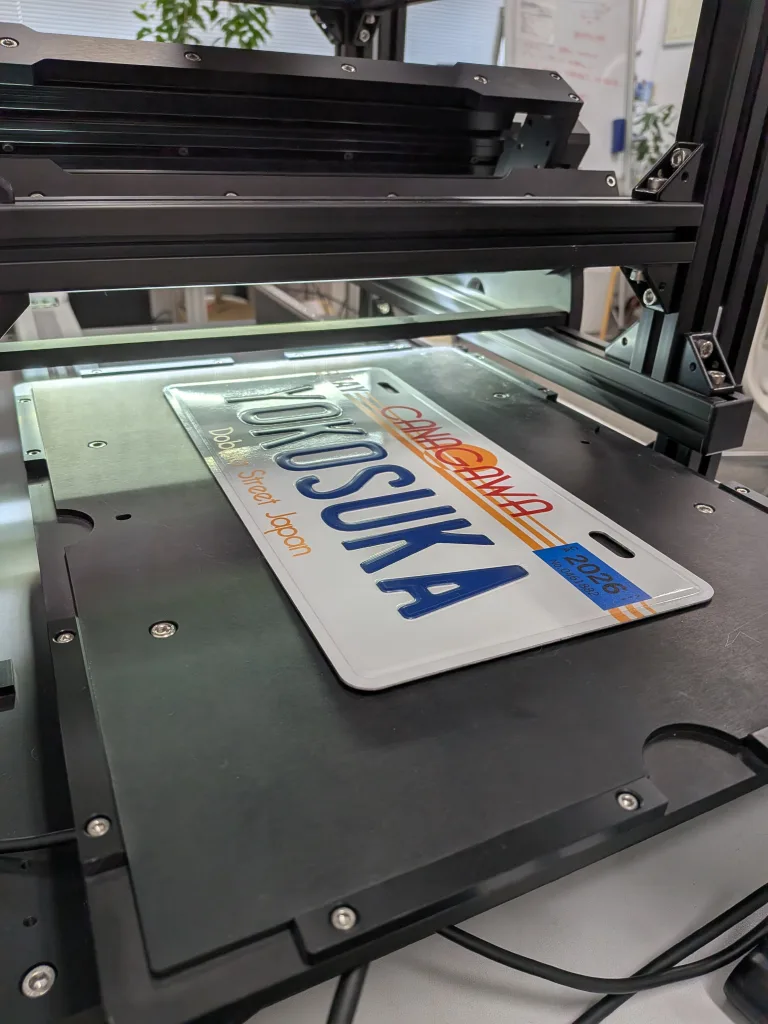
The YOKOSUKA license plate set on the TR-300 imaging stage
Why observe a license plate?
The decorative license plate we chose as a sample combines two elements that are convenient from an inspection-technology standpoint.
- Printed color graphics: "color information" that merely sits on a flat surface, such as the lettering color, background lines, and the year/month display
- Physical embossing: "shape information" where the surface itself is deformed, such as the raised letters formed by pressing and the rim around the edge
With an ordinary camera, these two mix, and you cannot tell whether you are seeing shades of color or real relief. That is what makes it the ideal sample for checking whether "shape alone can be extracted, ignoring color."
Capturing with light from four directions: Photometric Stereo
At the core of TR-300 is Photometric Stereo, a method that combines images captured with light from multiple directions and reconstructs the fine relief of the surface in three dimensions. It applies, with industrial precision, the same principle by which a step in the floor looks different depending on whether you shine a flashlight from the left or the right.
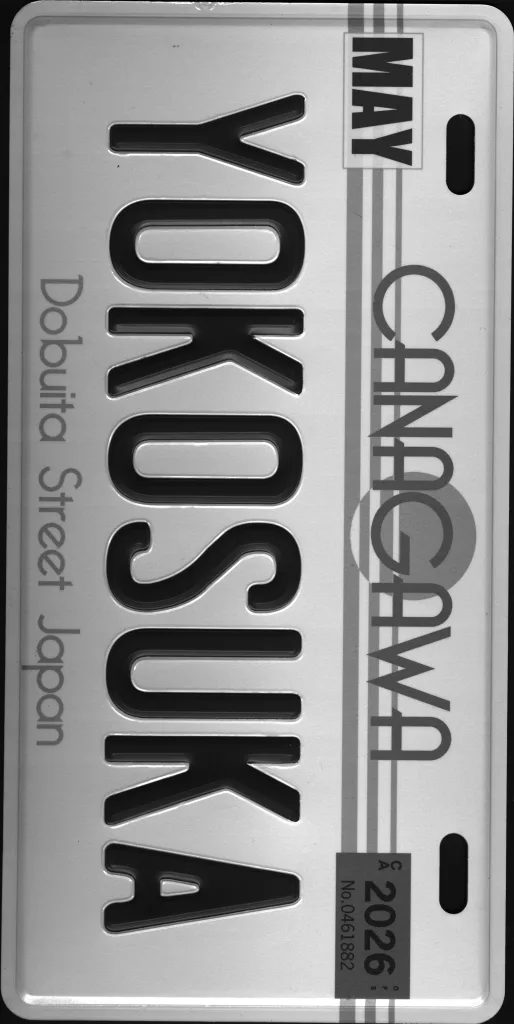
Channel 2 images captured under illumination from four directions
The side on which the shadows of the embossed letters fall changes with the direction of the illumination. These differences in shadow are the cues for calculating the surface slope (normal), and by combining information from multiple directions, the three-dimensional shape of the entire surface is reconstructed.
The star is the 3D surface image: color disappears, leaving only the embossing
This is the star of this post, the reconstructed 3D surface image.
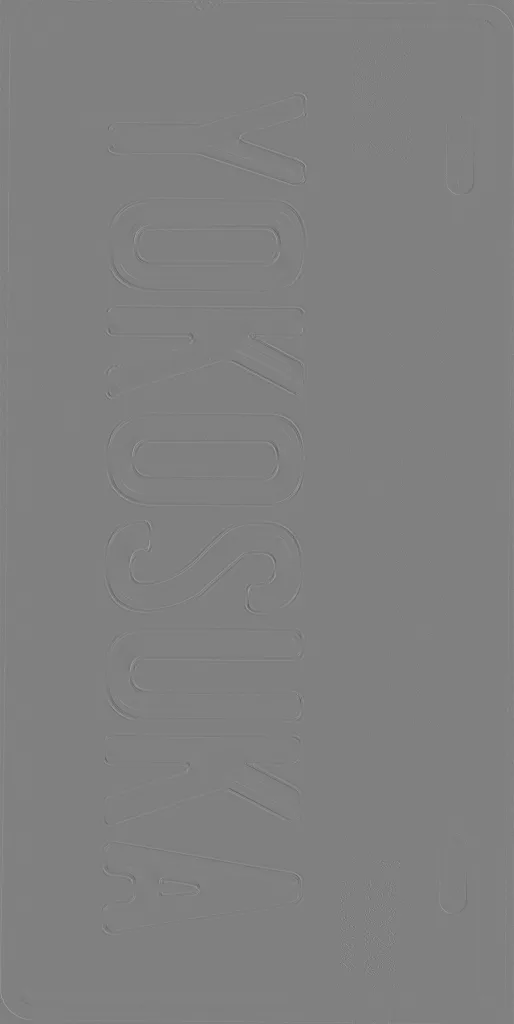
Reconstructed 3D surface image. The printed colors have disappeared and only the embossed pattern stands out
- The printed color graphics have almost completely disappeared. Color that merely sits on a flat surface does not exist as shape, so it does not appear in the 3D surface.
- Only the physically raised "YOKOSUKA" embossing remains, as smooth relief. Even the roundness of the letter corners and the rise of the edges can be read.
- At the lower right, fine scratch marks that printing cannot explain are also captured. Because they remain as shape rather than color, this is information visible precisely in the 3D surface.
In other words, TR-300 removes "what color sits on top" and extracts purely "what shape it has."
What "shape separated from color" means for inspection
This capability leads to the following value in on-site inspection.
- Read embossing under printing or paint: serial numbers and lot numbers can be checked without being misled by printing
- Strong against reflection: relief can be captured even on glossy materials such as metal and laminates, where reflections make scratches hard to see
- Tell defects from dirt: whether a black spot is a dent or dirt that wipes off can be separated by shape
Capturing fine relief on the scale of a few micrometers, even on a moving line: TR-300 is a system developed to bring this "eye for shape" into the inspection process.
Summary
- TR-300 is an AI visual inspection system that uses Photometric Stereo to reconstruct the three-dimensional shape of a surface from images illuminated from multiple directions.
- On the "YOKOSUKA" license plate, the printed colors disappeared and only the embossed pattern emerged as a 3D surface.
- Being able to separate color and shape connects directly to on-site challenges such as reading embossing, detecting scratches on glossy materials, and telling defects from dirt.
If you would like a demo or sample evaluation of surface observation or visual inspection with TR-300, please feel free to contact us.