

Logical Anomaly Detection Rankings Flip When Artificial Capture Shifts Are Mixed In
In visual inspection on production lines, AI finds defects by looking for differences from good parts. A new paper shows that methods scoring near-perfect AUROC on MVTec LOCO change places once artificial changes in brightness and image scale are mixed into the test.

Creating Pseudo-Defects "Just Outside Normal"
Visual inspection AI in factories is often trained on good parts only, so plausible defects are created artificially from normal images. GLASS (ECCV 2024) reports improved detection of faint and small defects by refining how these pseudo-defects are created.
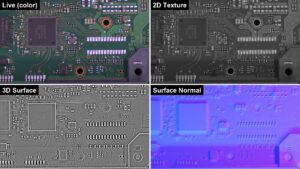
Seeing a Populated Circuit Board as "Color" and "Shape": PCB Visual Inspection and Four Image Representations
In visual inspection of populated circuit boards, specular reflections from solder and leads often make "shape" hard to read. We captured the control board of a commercially available HDD with TR-100 (FORESIGHT STEREO®) and compared the four image representations obtained from a single capture.

FORESIGHT STEREO® for Trading Card Surface Observation: Seeing the "Color" and "Shape" of Glossy Surfaces Separately
Glossy and holographic trading cards are difficult subjects: the printed artwork overlaps with surface reflections, making shallow dents and scratches hard to distinguish. Our 3D imaging technology FORESIGHT STEREO® can also be used to observe the surface of such cards.

What Happens to an Inspection AI When NG Images Slip into Training Data Meant to Be Good-Only?
Most visual inspection AI methods assume the training data is all good parts, yet on real floors a few defective images can slip into the training folder. We look at how SoftPatch (NeurIPS 2022) examines how far a model breaks when that assumption fails, and how to prevent it.

"99% on MVTec AD" Cannot Choose a Method: AUROC of 29 Industrial Anomaly Detection Methods Compared with Their Settings
When choosing an industrial anomaly detection method, many engineers look first at benchmark AUROC values, yet the leading methods crowd into the 99% range and the same metric name hides different settings. We share the four elements to check when reading AUROC, based on values of 29 methods collected from original papers and public benchmarks.

Same TR-100, Only the Lens Switched to High Magnification: Observing a Semiconductor Chip
What decides how a surface looks in inspection is often the design of conditions, which lens and which field of view, rather than the equipment itself. We fitted a high-magnification lens to the AI visual inspection system TR-100 and captured a semiconductor chip sample.
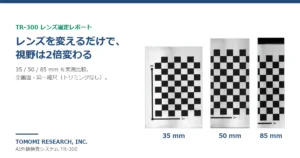
How Much Do Field of View and Resolution Change with Focal Length? Measured Comparison of 35 / 50 / 85 mm Line Scan Lenses
"Widen the field of view and resolution drops" is a principle everyone in visual inspection knows, but when choosing a lens what matters is how much it drops. We fitted 35, 50 and 85 mm line scan lenses to TR-300 and measured field of view, resolution and brightness.

A Hands-On Guide to Evaluating AI Anomaly Detection (4/4)
When companies introduce AI visual inspection, the part most often misunderstood is "evaluation." This tutorial lets you get a feel for thresholds, the confusion matrix, and ROC/PR/F1 curves by moving sliders in a free browser app.

A Hands-On Guide to Evaluating AI Anomaly Detection (3/4)
When companies introduce AI visual inspection, the part most often misunderstood is "evaluation." This tutorial lets you get a feel for thresholds, the confusion matrix, and ROC/PR/F1 curves by moving sliders in a free browser app.