[Tech Blog] SimpleNet: Four Remarkable Ideas That Changed Anomaly Detection
 kotai2003
Introduction
In manufacturing quality control, AI anomaly detection is becoming an essential technology. Yet missing even a single unpredictable, minute defect, such as a hairline scratch, a barely visible color unevenness or a slight misalignment of a part, is not acceptable. Conventional AI models often fell short of this strict requirement because of their complexity and the “domain barrier” between training data and data from the floor.
Against this background, SimpleNet, presented at CVPR 2023, delivered results that overturned conventional wisdom with, as its name suggests, remarkable simplicity. Without relying on complex statistical algorithms or huge memory banks, it outperformed the best existing models in both accuracy and speed.
SimpleNet: A Simple Network for Image Anomaly Detection and Localization
https://arxiv.org/abs/2303.15140
In this article, we explain in accessible terms, with a technical deep dive, the four remarkable ideas that made SimpleNet such a turning point.
1. Remarkable Simplicity: Dropping Complexity to Reach Top Accuracy and Top Speed
SimpleNet's greatest strength is the simplicity of its concept. Earlier high-performing anomaly detection models relied on advanced techniques such as memory banks and normalizing flows, and tried to learn “what the distribution of normal features looks like” with complex statistical models. While these performed well, they came with an enormous computational cost.
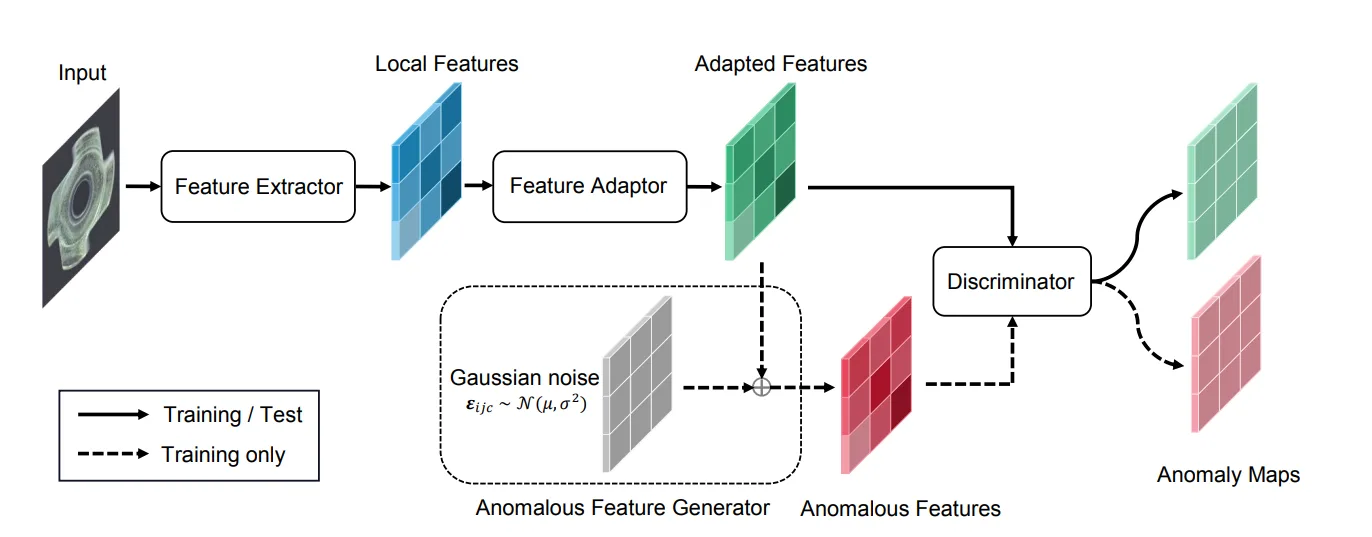
SimpleNet removes all of these complex elements and recasts the problem as a more direct classification task. In other words, it narrows the question to “where is the boundary between normal and anomalous?” This makes it possible to use a very simple multilayer perceptron (MLP) as the discriminator that judges whether something is anomalous or normal. In addition, the anomalous feature generator, used only during training, is discarded at inference, so the final model is a very simple single-stream classification architecture.
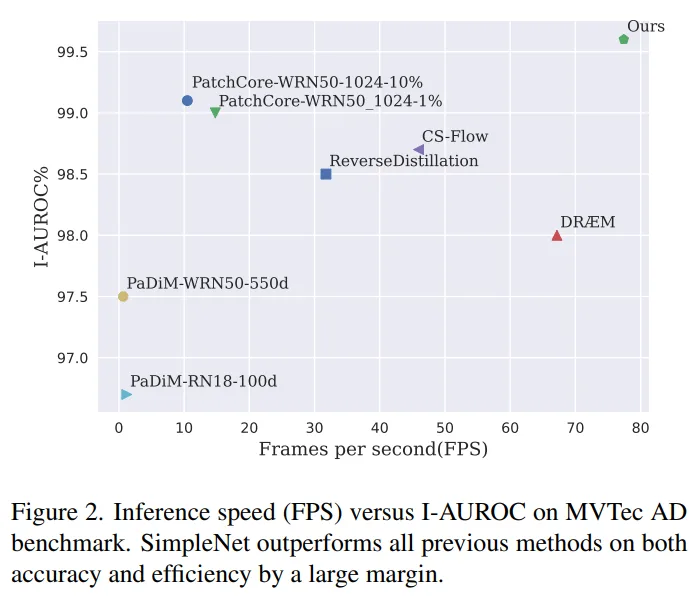
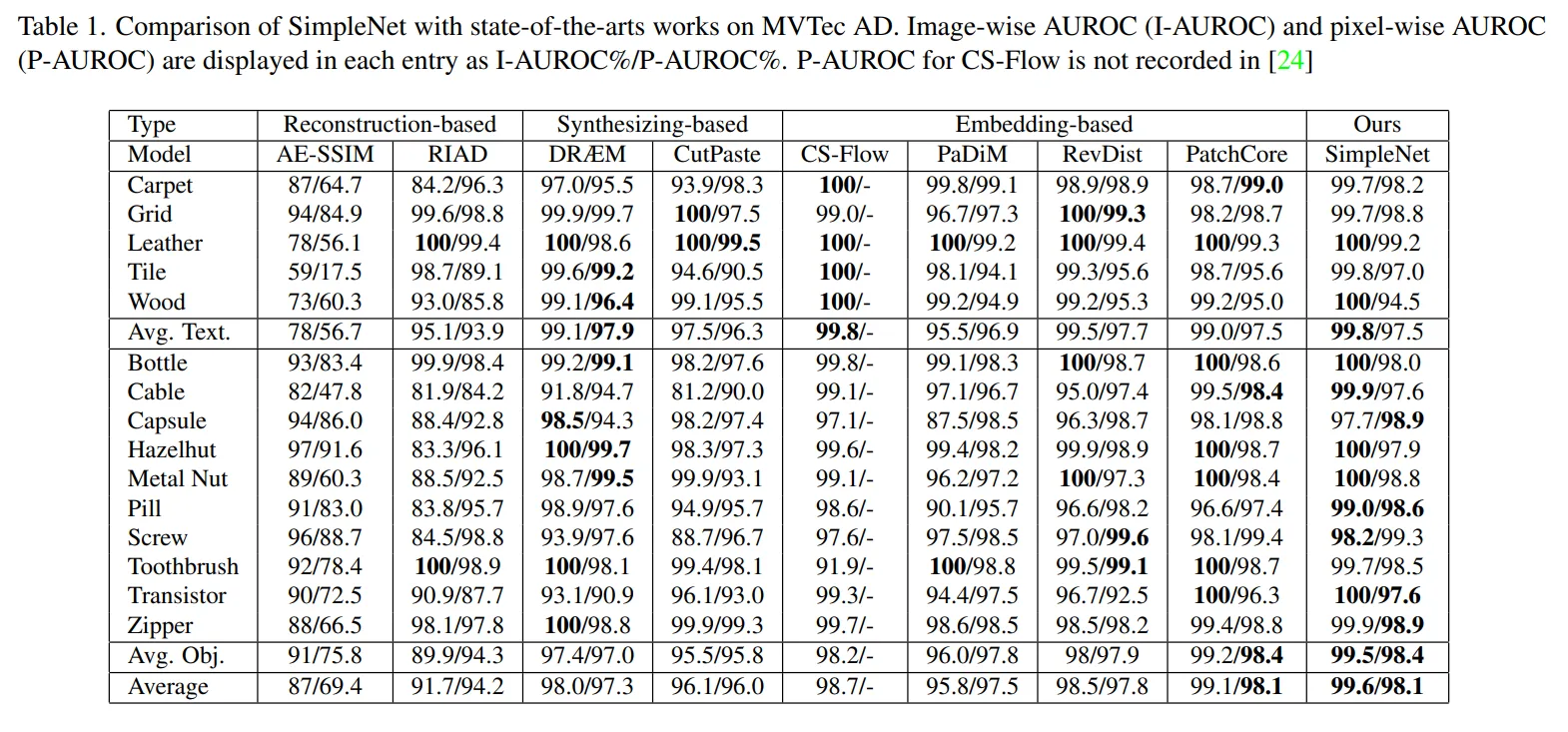
The results of this simplicity are remarkable. On the industry-standard MVTec AD benchmark, SimpleNet recorded 99.6% on the anomaly detection accuracy metric (AUROC) and ran at 77 FPS, about 8 times faster than the strong competing model PatchCore. Combining top-level accuracy with practical speed shows that SimpleNet is very well suited to industrial applications.
2. A Change of Perspective: Generating Anomalies in Feature Space, Not in the Image
Another original idea behind SimpleNet's success is how it generates “fake anomalies.” Training an anomaly detection model requires anomalous data, but in practice there is never enough of it. So the common approach is to generate anomalies artificially from normal images.
Earlier methods tried to draw realistic defects, such as scratches or missing areas, directly onto normal images. SimpleNet instead generates anomalies not in the image itself but in the feature space, the data the AI extracts in order to understand the image. This resembles the idea in natural language processing (NLP) of representing words as vectors. Just as NLP manipulates a word's semantic “position” rather than the word itself, SimpleNet manipulates the essential “features” of an image rather than its pixels.
The process is very simple. First, features are extracted from normal images. Next, simply adding Gaussian noise to that feature data produces “anomalous features.” All that remains is to train the model to distinguish the original “normal features” from the noise-added “anomalous features.” The authors describe the core of this approach as follows:
Second, generating synthetic anomalies in feature space is more effective, as defects may not have much commonality in the image space.This change of perspective is very powerful. There is no longer any need to predict and generate the appearance of every conceivable defect (scratches, stains, chips and so on), which makes it possible to build robust models that can also handle more general and unknown defects.
3. The Feature Adaptor: A Clever Move That Breaks the Domain Barrier
Many anomaly detection models are based on models pre-trained on general image datasets such as ImageNet. However, the data distribution of the highly varied photos in ImageNet (dogs, cats, cars and so on) differs greatly from that of the uniform images of industrial products captured on a production line. This “domain bias” was one cause of reduced model performance.
SimpleNet solves this problem with a very clever move: the Feature Adaptor. The Feature Adaptor is an extremely simple component consisting of just a single fully connected layer.
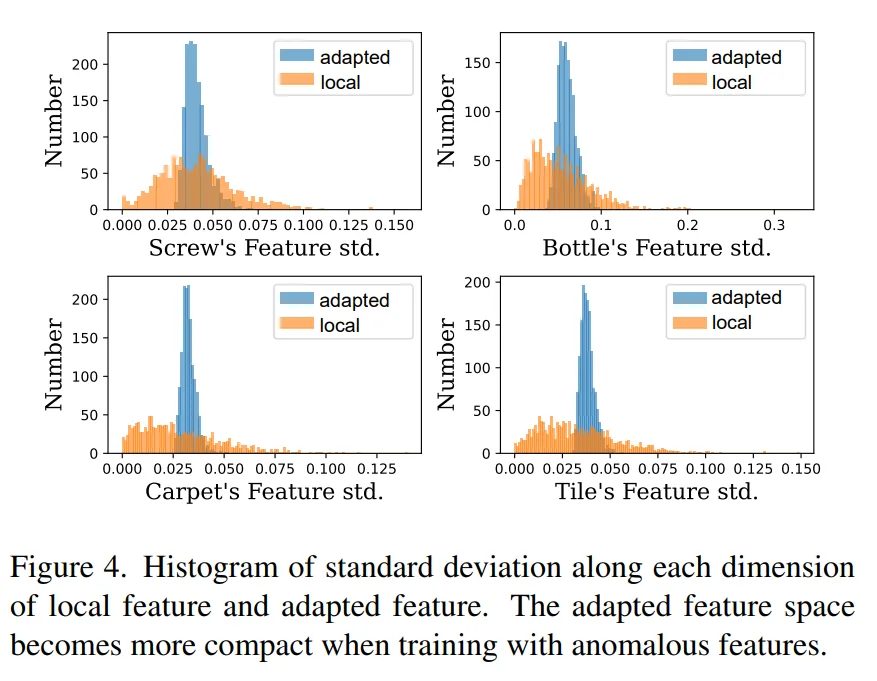
Its role is to project (transform) the features extracted by the pre-trained model into a new feature space optimized for the target domain (images of industrial products). Experiments show that building this adaptor into training makes the feature space more compact, that is, it reduces the spread of normal features, which makes it easier to draw the boundary with anomalies. This simple addition breaks the domain barrier, speeds up model convergence and improves final detection performance.
4. A Major Performance Gain: A Breakthrough That Cut the Error Rate by 55.5%
The performance gain SimpleNet brought is not a mere incremental improvement. It can be called a breakthrough of great importance for industrial applications.
The clearest sign of its impact is the reduction in error rate on the MVTec AD benchmark. SimpleNet lowered the error rate from 0.9% for PatchCore, the previous best-performing model, to 0.4%. This corresponds to a 55.5% reduction in errors. In terms of numbers, it means that when inspecting 1,000 products, the defective items missed drop from 9 to 4. This difference has a direct impact on quality assurance and cost reduction on large-scale production lines.
This result has been highly regarded as bridging the gap between academic research and industrial application. The paper's conclusion also stresses its importance as follows:
SimpleNet provides a new perspective to bridge the gap between academic research and industrial application in anomaly detection and localization.
Summary
The stone SimpleNet cast into the field of anomaly detection shatters the long-held assumption that complexity is the path to better performance. Its essence lies in a combination of simple yet original ideas.
- Remarkable simplicity: it dropped complex statistical processing and returned to a classic classification problem.
- Anomaly generation in feature space: by adding noise to features rather than images, it achieved more general-purpose learning.
- Feature Adaptor: it added a simple, clever move that breaks the domain barrier.
- Outstanding performance: as a result of the above, it achieved a breakthrough that more than halved the error rate.