
FORESIGHT STEREO® for Trading Card Surface Observation: Seeing the "Color" and "Shape" of Glossy Surfaces Separately
 kotai2003
Glossy and holographic trading cards are difficult subjects: the printed artwork overlaps with reflections on the surface, making shallow dents and scratches hard to distinguish. Our 3D imaging technology FORESIGHT STEREO® can also be used to observe the surface of such cards.
In this article, we walk through, one by one, the output images from capturing a card’s surface with TR-55, a surface 3D observation unit equipped with FORESIGHT STEREO® technology. We hope you will see for yourself, image by image, how the printed colors and patterns and the shape of the surface separate in the same single capture.
What card grading and inspection need to see
In card grading and inspection, the following is generally required:
- Subject: cards of approximately 63.5 × 88.9 mm
- Surface finishes: glossy, chrome, refractor, matte, textured
- Defects to detect: shallow dents, impressions, scratches, print lines, surface waviness
- Imaging requirements: a field of view that captures the whole card in one shot, high resolution, and output of per-direction raw images, normal maps and 3D surface data
On glossy or holographic surfaces, reflections and colors change greatly with the viewing angle. The goal is to capture the shallow dents and waviness on top of that, separately from the printed artwork. FORESIGHT STEREO® technology, which images the shape of a surface, can help with this challenge that specialists in the field face every day.
In “A single top-down shot cannot reveal surface relief: Surface 3D Observation Unit TR-55,” published in July 2026 (in Japanese), we used a UK £2 coin to show that “color and shape separate in a single capture.” This article is an applied follow-up to it.
Capturing with TR-55: first, the appearance as it is
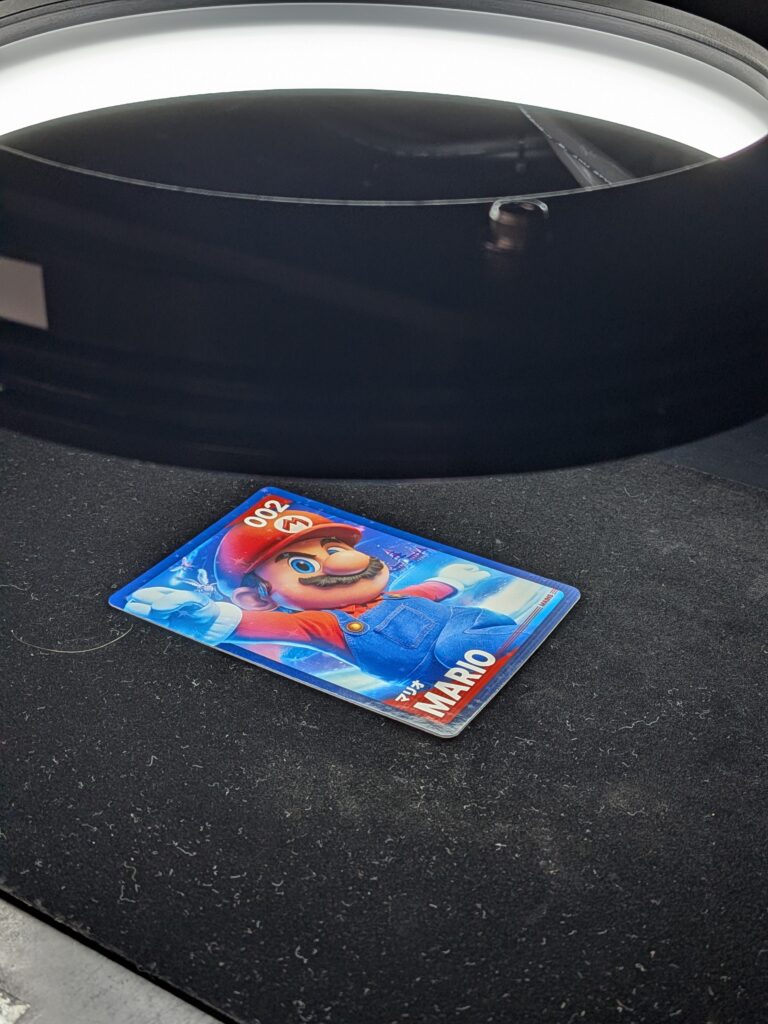
The capture setup. The card is placed on a black stage and lit from above by the TR-55 ring light. © Nintendo
TR-55 is a benchtop unit for observing the surface of an object in three dimensions. With FORESIGHT STEREO®, our 3D imaging technology developed independently from Photometric Stereo (a technique that determines surface orientation from multiple images taken with the lighting direction changed), multiple outputs are obtained from a single capture. The images below are outputs (3840×2160 px) of the GUI application FORESIGHT STEREO Viewer.
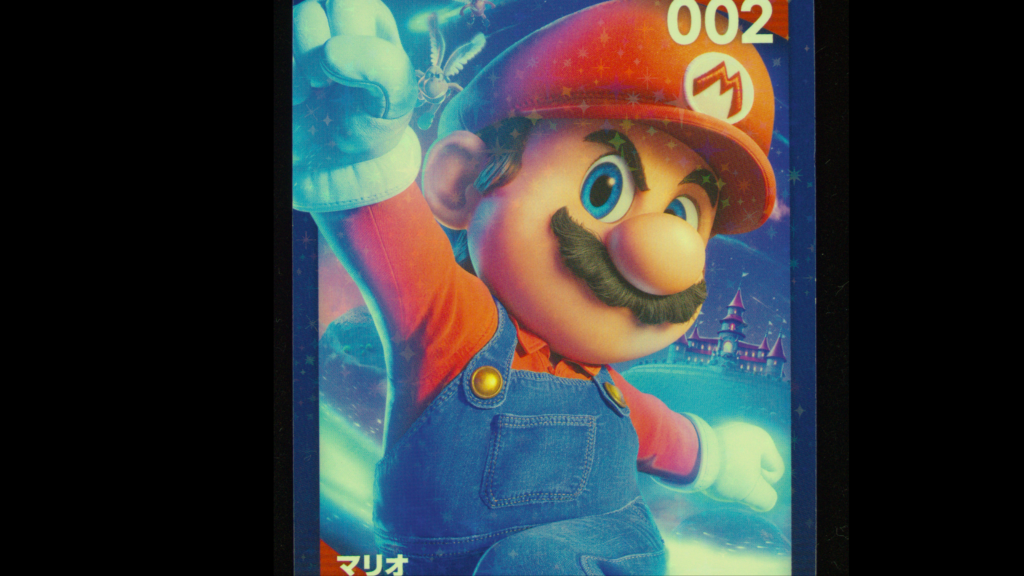
LIVE image. A color image just as it looks. © Nintendo
First, the LIVE image, just as it looks. The card artwork appears in color, and you can see star-shaped sparkle patterns (a holographic/foil-style finish) scattered across the whole artwork.
Because the card was placed vertically this time, its top and bottom edges are cut off outside the frame. We return to capturing the whole card in one shot later in this article.
The colors and patterns disappear, the shape remains: the surface normal map
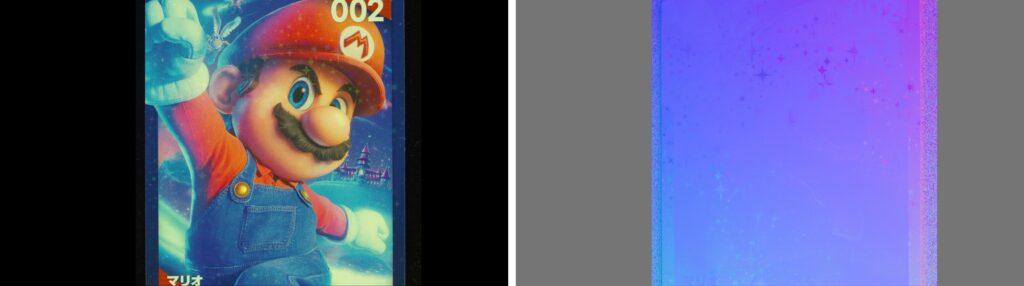
Left: LIVE image / Right: surface normal map. Both are outputs from the same single capture. © Nintendo
This comparison is the highlight of this article. The surface normal map on the right is an image that represents, by color, which direction each point of the surface faces.
To use an analogy, it is like a map that records only the “tilt” of the paper surface itself, not the pattern printed on the paper. Where the surface faces the same direction, the color is the same, and the color changes where the orientation changes. As a result, differences in ink color hardly appear on this map.
The colors of the character artwork have almost disappeared, and the whole image has become a uniform blue-violet tone. Within it, the star pattern stands out clearly. The number “002” and the outline of the character remain only very faintly.
In other words, the “printed colors and patterns” and the “surface orientation information,” which looked mixed together in the LIVE image, are seen separately here. Note that we have not yet evaluated whether the star pattern is due to surface relief (embossing) or to differences in reflective properties.
Emphasizing relief with color: the 3D surface color map
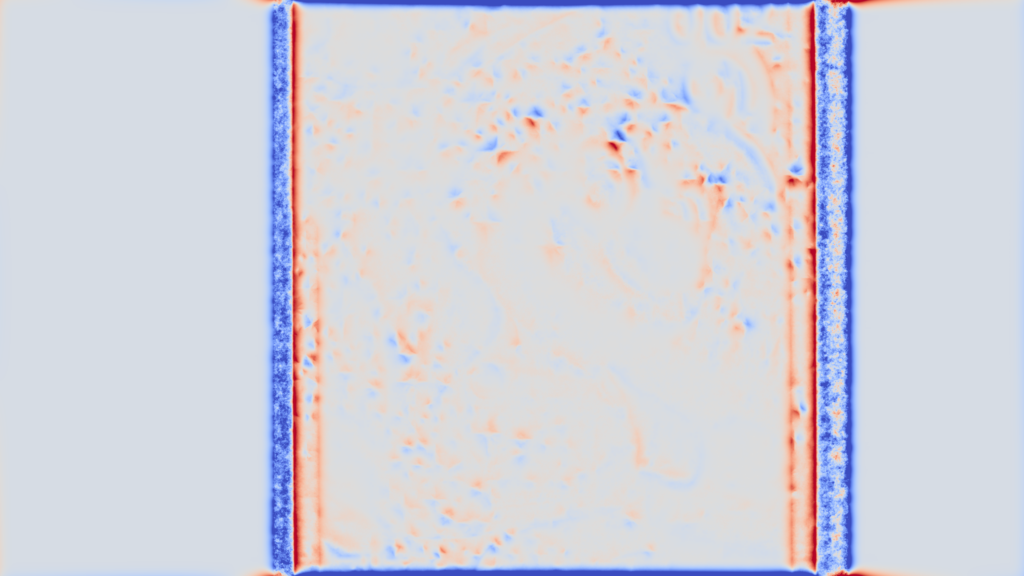
Enhanced 3D surface color map. The colors are a display that emphasizes relative height; they do not indicate depth values or defects. © Nintendo
This is the surface shape reconstructed from the normal map, displayed with colors emphasizing height. Gentle undulations appear across the whole card surface in colors from red to blue, with local height changes appearing somewhat concentrated near the upper center. Strongly colored bands appear along the left and right edges.
The colors here are only an emphasized display of relative height. They are not dimensional or depth measurement results, nor do they indicate the location of defects.
While the normal map shows “the orientation of the surface,” this color map is for getting an overview of “the shape of the whole surface.” Its role is to let you survey the undulations of a surface in a single image, even for an object like a card that looks thin and flat.
A configuration for card inspection
For the general card grading and inspection requirements listed above, TR-55 is expected to be able to meet them with the following configuration.
- Field of view: TR-55 is expected to be able to capture the whole card in one shot.
- Spatial resolution: with a 3840×2160 camera configuration, it is expected to be approximately 30 to 32 µm/pixel, depending on the field of view.
- Lighting: the lighting diameter can be configured up to a maximum of 160 mm or 200 mm. We consider this an advantageous configuration for capturing shallow dents, impressions, scratches and waviness on highly glossy, highly reflective cards.
- Capture conditions: for accurate evaluation, we recommend capturing cards outside their protective cases or holders.
Bring the data into your own processing
TR-55 can output the following data:
- Per-direction light source images (raw images for each lighting direction)
- 2D texture images (color and pattern information)
- Surface normal maps (surface orientation information)
- Reconstructed 3D surface data
Beyond viewing them on screen, you can bring these into your own image processing pipeline and use them for decision logic and analysis.
Beyond cards, there are many subjects where you want to see color and pattern separately from surface shape, such as glossy printed materials, decorative surfaces and films. FORESIGHT STEREO® technology may also be applicable to surface observation of such glossy and printed surfaces.
Summary: an option to see color and shape separately when observing card surfaces
With TR-55, equipped with FORESIGHT STEREO® technology, the same single capture gives you both a LIVE image that looks just as the card does and an image in which the printed colors and patterns almost disappear and the surface orientation remains. Even card surfaces that are hard to distinguish because of gloss or holographic finishes can be observed with “color” and “shape” separated.
A lighting configuration designed for the surface conditions that card grading and inspection need to see, such as shallow dents, impressions, scratches, print lines and waviness, is also possible. The output data can be used directly in your own decision-making and analysis.
A capture demo with your own cards
Businesses interested in surface observation of trading cards, or of glossy and printed surfaces in general, are welcome to contact us. We are happy to discuss a capture demo using your own cards or samples of glossy or printed surfaces.
Contact: TOMOMI RESEARCH Inc.
info@tomomi-research.com / Tel: 0466-54-9003 (from outside Japan: +81-466-54-9003)
* The images shown are an example of observing the surface of a single card and do not guarantee results for all subjects and conditions. They are also not dimensional or depth measurement results.
* Card images © Nintendo
This article is not affiliated with Nintendo Co., Ltd.
“FORESIGHT STEREO” and “E3 ENGINE” are trademarks or registered trademarks of TOMOMI RESEARCH Inc.

