[Tech Blog] Rethinking AI Anomaly Detection: What Is Dinomaly, a High-Accuracy Multi-Class Detection Method?
 kotai2003
AI-based anomaly detection is indispensable in quality control on the factory floor and in medical diagnosis. Yet handling a wide variety of products or cases has tended to require many AI models. Dinomaly, which we introduce here, is a new technique that overturns this assumption: simple, yet high-performing. It detects multiple kinds of anomalies with a single AI model, and its accuracy is remarkable.
Paper Overview: Dinomaly, a New Method That Captures Complex Anomalies Simply
The research paper "Dinomaly: The Less Is More Philosophy in Multi-Class Unsupervised Anomaly Detection" proposes a breakthrough approach to overcoming long-standing challenges in the field of multi-class unsupervised anomaly detection (MUAD).
Link:
Research Aim and Challenges
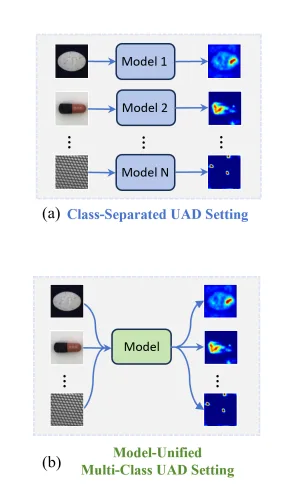
Until now, AI anomaly detection has mainly followed a "class-separated" approach, preparing a separate model for each type (class) of target object. With this approach, however, the number of models needed grows enormously as targets increase, and the cost of managing and operating them becomes a heavy burden.
This is where multi-class unsupervised anomaly detection (MUAD), which detects multiple classes with a single model, comes in. MUAD, however, faced a major challenge called "identity mapping": the AI model learns diverse normal patterns so thoroughly that it reconstructs even anomalous patterns it has never seen as "normal". When that happens, anomalies cannot be found.
Dinomaly's Approach: Four Simple Elements
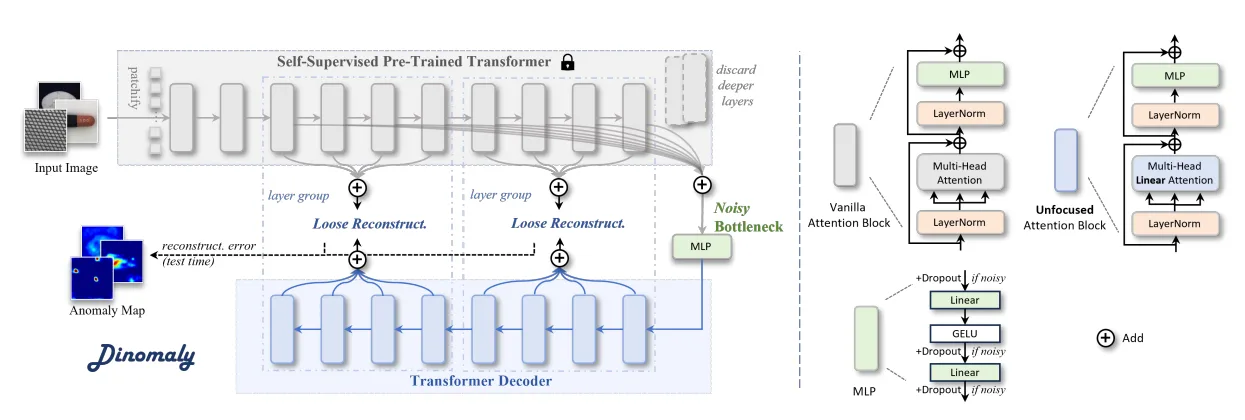
Based on the philosophy of "Less Is More," Dinomaly solves this problem without relying on complex designs or special modules, using only a pure Transformer, a basic AI architecture, and the following four simple elements.
- Using a scalable foundation Transformer
- Transformer: A high-performance basic AI model architecture that drew attention in natural language processing and has recently been applied to image processing as well.
- Dinomaly uses a high-performance Vision Transformer (ViT), pre-trained on large-scale image data, as its encoder (feature extractor). This lets it efficiently extract universal, highly discriminative features from images. The method has been shown to follow a "scaling law": performance improves as the model size (from ViT-Small to ViT-Large) and the input image resolution increase.
- Noisy Bottleneck
- MLP (multi-layer perceptron): One of the basic layers of a neural network.
- To prevent the AI from "over-generalizing" (treating anomalies as normal), Dinomaly makes effective use of Dropout, a mechanism already present in the MLP bottleneck, instead of adding new modules. By randomly stopping the activity of neurons (the AI's nerve cells) during training, Dropout encourages the network to reconstruct normal features regardless of anomalies, suppressing identity mapping.
- Unfocused Linear Attention
- Attention: The main mechanism of a Transformer, which learns where in an image to focus.
- Conventional attention (Softmax Attention) tends to concentrate excessively on specific regions, which carries a risk of identity mapping. Dinomaly adopts Linear Attention in its decoder (reconstructor). Unlike Softmax Attention, Linear Attention does not strongly "focus" on local regions and spreads attention across the whole image. This prevents identical information about unseen anomalous patterns from being passed to the next layer, while also reducing computational cost.
- Loose Reconstruction
- Loose Constraint: In conventional reconstruction methods, each encoder layer was strictly imitated by the corresponding decoder layer, which could also cause identity mapping. Dinomaly treats the feature maps obtained from multiple layers together as "one group." This lets the decoder reconstruct images more flexibly and behave differently from the encoder on unseen anomalies.
- Loose Loss: In addition, Dinomaly uses a special loss function, the "hard-mining global cosine loss," which deliberately suppresses the gradient during training (the direction of weight adjustment) for well-reconstructed parts (feature points with low cosine distance). This prevents the AI from over-learning normal regions and missing anomalies.
Remarkable Experimental Results
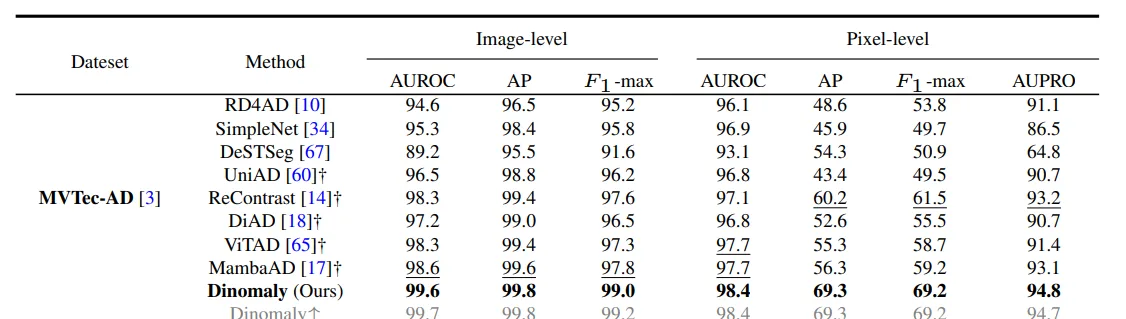
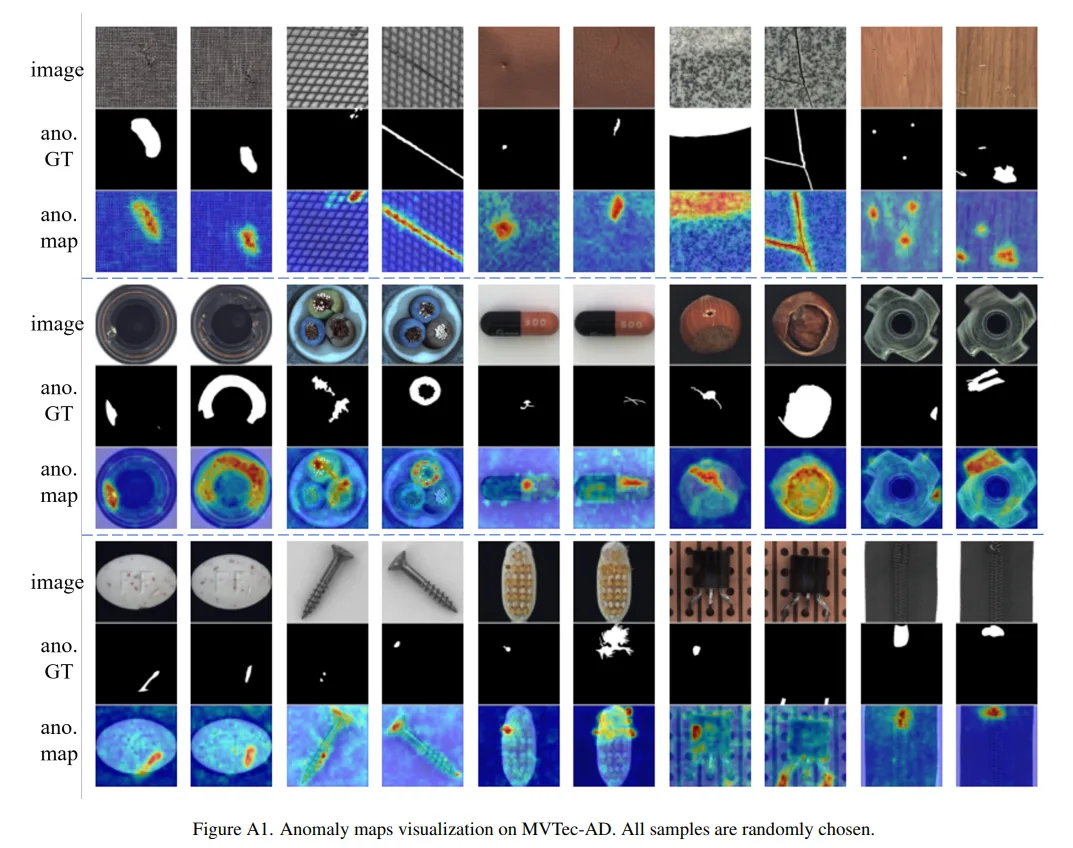
Dinomaly was evaluated extensively on major anomaly detection benchmarks: MVTec-AD, VisA and Real-IAD. It substantially outperformed existing MUAD methods, recording remarkable image-level AUROC scores (a metric of anomaly detection accuracy) of 99.6% on MVTec-AD, 98.7% on VisA and 89.3% on Real-IAD. This is accuracy comparable to, or even higher than, state-of-the-art class-separated anomaly detection models that prepare a separate model for each class, demonstrating that high-accuracy anomaly detection with a single model is possible even in complex scenarios.
Significance and Potential Applications: Major Benefits for the Field
The results of the Dinomaly research bring unprecedented benefits to manufacturing and R&D.
- Far less cost and effort:
- Because a single AI model can handle multiple product lines and inspection targets, the cost and effort of developing, training and managing models are drastically reduced.
- There is no longer any need to store a model for each class, so storage costs can also be reduced.
- More efficient deployment and operation:
- Even when new products are introduced or manufacturing processes change, the existing model can be used as is, greatly shortening the lead time for retraining or adding models.
- This enables a rapid response in today's fast-changing business environment.
- High-accuracy quality control:
- It overcomes the performance drop that was a challenge for conventional MUAD, achieving anomaly detection accuracy equal to or higher than the class-separated approach.
- This makes it possible to minimize the risk of missing product defects or production line anomalies, improving quality and reliability.
- Adaptability to diverse sites:
- Dinomaly has shown high practicality as a unified model in complex real-world scenarios, such as high-mix, low-volume manufacturing, inspection of automotive parts and precision machinery, and even screening for a wide variety of diseases in the medical field.
- In particular, by adjusting the model size and input image resolution, it has the potential to flexibly accommodate diverse computing resources and requirements, from high-speed processing on edge devices to high-definition inspection.
Dinomaly has shown a new possibility in multi-class unsupervised anomaly detection: top-tier accuracy can be achieved with a simple approach. This is likely to solve many of the challenges in deploying and operating AI anomaly detection, and to bring major change to manufacturing and many other fields.
At TOMOMI RESEARCH, we carry out research and development every day so that we can bring innovative technologies like this to our customers' sites as quickly as possible. If you are interested in our AI solutions, please feel free to contact us.
Contact us https://www.tomomi-research.com/en/contact
See TOMOMI RESEARCH products and solutions https://www.tomomi-research.com/download