
TR-300, AI Visual Inspection That Detects Fine Scratches on Glossy Materials on a Moving Line, Wins the Encouragement Award
 kotai2003
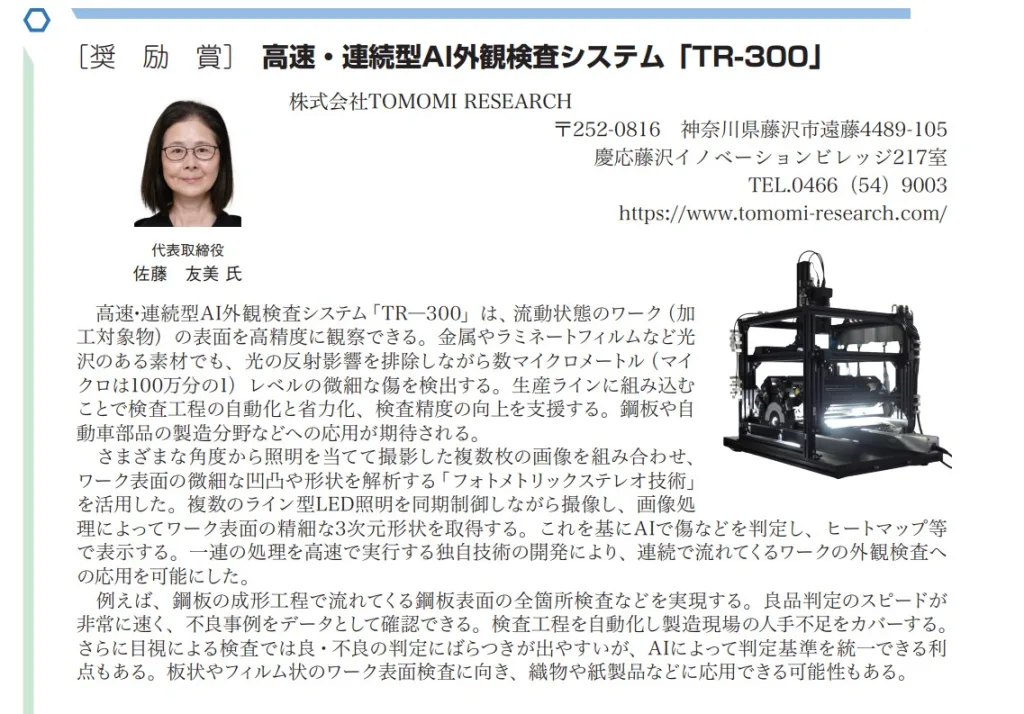
We are pleased to announce that TOMOMI RESEARCH's “High-Speed Continuous AI Visual Inspection System TR-300” has received the Encouragement Award of the 38th Small and Medium Enterprise Excellent New Technology and New Product Award (organized by the Resona Foundation for Small and Medium Enterprise Promotion, co-organized by Nikkan Kogyo Shimbun). The award was also covered in the Nikkan Kogyo Shimbun on Wednesday, April 15, 2026. In this article, in addition to reporting the award, we explain in plain terms, for people working on the manufacturing floor, why glossy materials are hard to inspect and how the TR-300 solves that problem.
The Award, and Our Thanks
The Small and Medium Enterprise Excellent New Technology and New Product Award is a prestigious award program with a 38-year history that recognizes the technologies and products of small and medium-sized enterprises. Having the TR-300 selected for its Encouragement Award is a great encouragement to us.
We sincerely thank our customers and partner companies who support the development and validation of the TR-300, and the people in manufacturing who give us honest feedback from the floor. This award would not have been possible without the dialogue we have built up with all of them.
Why Is Visual Inspection of Glossy Materials So Hard?
If you work in manufacturing quality control, you have probably faced problems like these at least once:
- Light reflects off the surface of metal parts or laminated film, so the camera cannot capture scratches well
- You have to rely on the visual judgment of skilled inspectors, and pass/fail decisions vary from person to person
- You want to inspect every workpiece coming down the line, one by one, without slowing the line
- With labor shortages you want to automate more of the inspection process, but you hesitate because you have heard AI image inspection struggles with glossy materials
On glossy materials, reflections change greatly depending on how the light hits the surface, so with conventional camera imaging it has been hard to tell whether you are looking at a scratch or a reflection. This is why, even as AI image inspection has spread, it has been said to be weak on shiny materials such as metal and film.
How the TR-300 Works: Integrating Photometric Stereo and AI
The TR-300 is a visual inspection system developed to take on this barrier in glossy-material inspection head-on. At its core is a method called Photometric Stereo.
What Is Photometric Stereo?
Put simply, Photometric Stereo is a technique that combines images captured with light shone from multiple angles to capture the fine relief of a surface in three dimensions.
As an everyday example, at night the slight bumps in a floor look different when you shine a flashlight from the left and from the right. The TR-300 is an industrially refined, precise version of this: it captures images while controlling multiple line-type LED lights in sync, and obtains the 3D shape of the workpiece surface through image processing.
AI Judgment and Heat Map Visualization
Based on the resulting 3D shape data, AI judges whether something is a scratch or a harmless texture. The results are displayed visually as a heat map, so you can see at a glance where a defect is and how severe it is.
Because this whole process runs at high speed, the TR-300 can inspect not only stationary workpieces but also moving workpieces, that is, workpieces that keep flowing down the line. This is one of its key features. It is designed to combine the precision to capture fine scratches at the level of a few micrometers (one micrometer is one millionth of a meter) with the speed for continuous processing.
Expected Applications
The TR-300 is expected to be used in fields such as:
- Steel sheet forming: continuous inspection of the entire steel sheet surface
- Automotive parts manufacturing: visual quality checks of metal parts
- Sheet and film workpieces: surface inspection of laminated film and similar materials
- Textiles and paper products: potential application to textured materials
Because it performs well on glossy materials, we believe it can extend the option of automation and labor saving to processes that until now had to rely on visual inspection.
Three Points That Were Recognized
We believe the recognition the TR-300 received can be summed up in the following three points:
- Originality of the technology integration: Photometric Stereo, high-speed image processing and AI judgment designed as one system
- Completeness at a practical level: built as a configuration that works not just in the lab but on a moving production line
- Fit with real manufacturing challenges: offering an answer to the long-discussed floor issues of labor shortages, inconsistent inspection, and the difficulty of glossy materials
Behind the Development: A Comment from Our CTO
“We are deeply honored to receive the Encouragement Award of the prestigious Small and Medium Enterprise Excellent New Technology and New Product Award. The TR-300 is a product that takes on, head-on, visual inspection of glossy materials, an area long considered ‘difficult for AI’ on the manufacturing floor. By integrating Photometric Stereo, high-speed image processing and AI judgment, we have achieved inspection that catches scratches on the scale of a few micrometers, even on a moving production line.
Japanese manufacturing faces the challenge of securing quality while short of labor. We will keep developing our technology so that the TR-300 can be a reliable option for meeting that challenge.”
Dr. Seong-Hun Choe, CTO, TOMOMI RESEARCH, Inc.
Looking Ahead
We will continue to broaden the range of applications of the TR-300 and improve its performance. To handle the different workpiece shapes, materials and line speeds of each site, we plan to keep making improvements at every layer: lighting design, image processing and AI models.
By turning the defect cases found in inspection into data, we also aim to offer value as a traceability foundation that supports the quality improvement loop. We hope the TR-300 can serve your floor not simply as “a machine that finds scratches” but as “a partner for continuously raising the quality of manufacturing.”
Summary
- The “High-Speed Continuous AI Visual Inspection System TR-300” received the Encouragement Award of the 38th Small and Medium Enterprise Excellent New Technology and New Product Award
- It uses a proprietary approach that combines Photometric Stereo with AI judgment to detect fine scratches on glossy materials on a moving line
- It has potential applications across a wide range of materials, including steel sheet, automotive parts, film, textiles and paper
- It aims to answer, at a practical level, the floor challenges of labor shortages, inconsistent inspection, and the difficulty of glossy materials
Please feel free to contact us for detailed TR-300 materials or to discuss a demo.
We also handle specific questions individually, such as whether it can be used in your inspection process and which lighting configuration would suit it.
- TOMOMI RESEARCH, Inc.
- URL: https://www.tomomi-research.com/en/
- TEL: +81-466-54-9003
- Address: Room 217, Keio Fujisawa Innovation Village (SFC-IV), 4489-105 Endo, Fujisawa, Kanagawa 252-0816, Japan