VerdictAD Explained: Post-Hoc Refinement to Reduce False Positives Without Retraining
 kotai2003
A difference is not a defect. Yet most few-shot anomaly detectors treat any deviation from a handful of good samples as suspicious, so normal variation triggers alarms while some real defects are poorly localized. A new preprint, VerdictAD, proposes a practical fix: leave your existing detector as it is, and add a second opinion from a frozen judge model on top of its output. Here is what the method does, what the paper reports, and where its limits lie.
Our explainer video on VerdictAD (narration in Japanese): watch on YouTube
The problem: few-shot anomaly detection confuses "different" with "defective"
Few-shot anomaly detection uses only one to four images of good parts as a reference and flags regions that look different in the inspected image. It saves you from collecting large training sets, but it has two weak spots:
- False positives on normal variation. The color of a juice or the orientation of a screw can differ from the reference without being a defect.
- Misplaced logical anomalies. When something that should be there is missing, such as an item absent from a breakfast box, the local difference is small, and the detector often fails to point to the right location.
On a production line, the first problem means extra manual re-checks. The second can lead to missed defects.
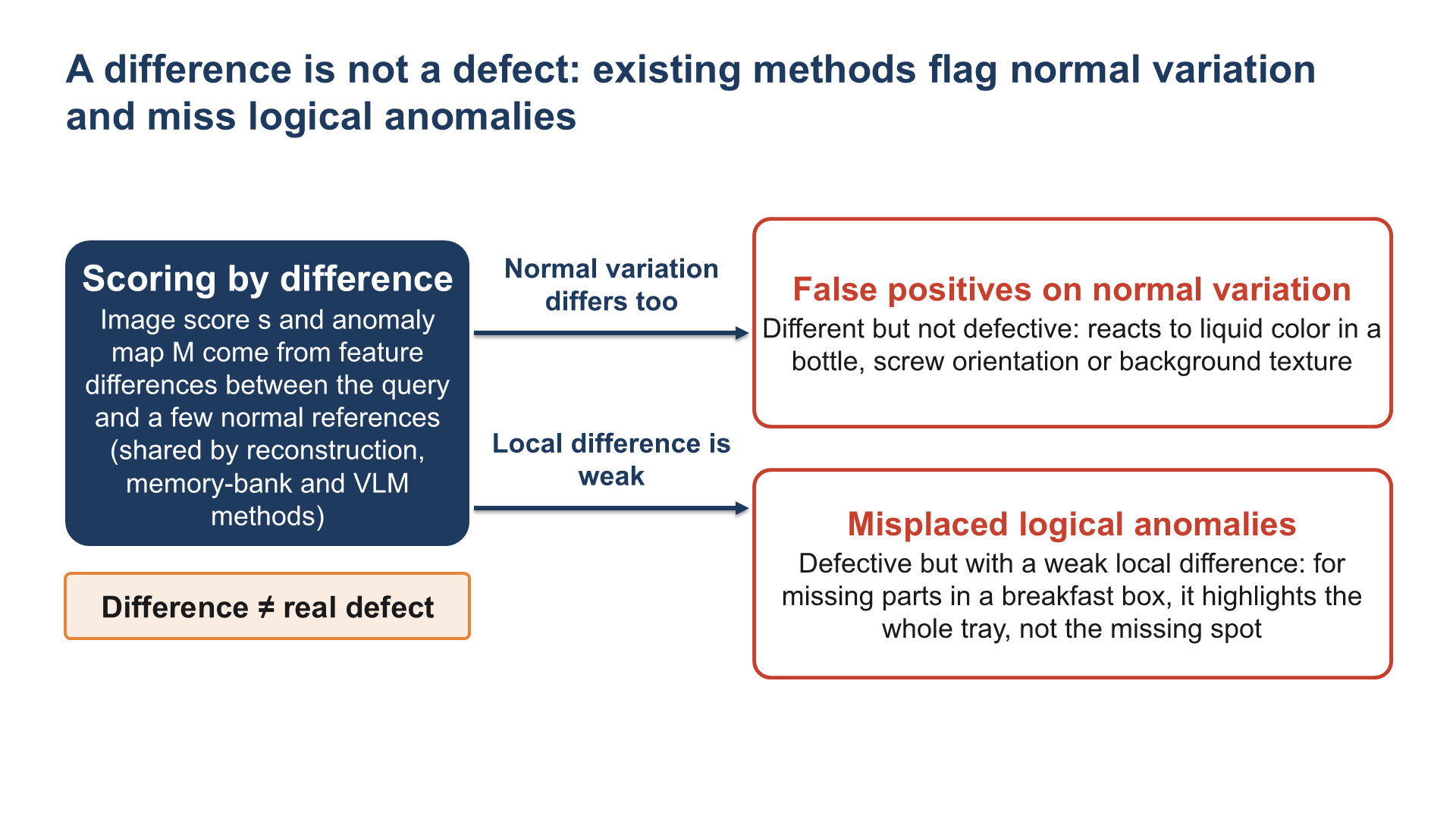
A visual difference is not a defect: existing methods flag normal variation and miss logical anomalies. Created by TOMOMI RESEARCH based on Sun et al., arXiv:2611.02654.
What VerdictAD does: a second opinion, not a new detector
VerdictAD does not change the architecture or training of the underlying detector (PatchCore and similar methods). Instead, it takes the detector's anomaly score and anomaly map and asks a follow-up question, much like asking an inspector, "Is this really a defect?"
The "inspector" here is not a person. It is a frozen 9-billion-parameter judge model called Clef-Flash, used without any additional training. In our video we call it a "judge AI," but in practice it is this frozen model. It does not generate text. It returns Yes/No probabilities directly, and VerdictAD multiplies the original score by a coefficient based on that probability. Regions the judge considers unlikely to be defects are suppressed, while defect-like regions remain.
The refinement runs at two levels:
- GVR (Global Verdict Refinement), image level: The judge answers once without a reference and once with the reference images arranged in a 2×2 grid. The two results are averaged and applied to the image-level score.
- LVR (Local Verdict Refinement), region level: The image is split into 16 windows, and each window is judged from two viewpoints: a cropped view, which the authors describe as suited to fine defects such as scratches and cracks, and a full image with a red box around the window, which they describe as suited to context-dependent anomalies such as missing or misplaced parts.
The paper reports that the detector and the judge model work best together: the combination is more accurate than the judge model alone, and the two complement each other.
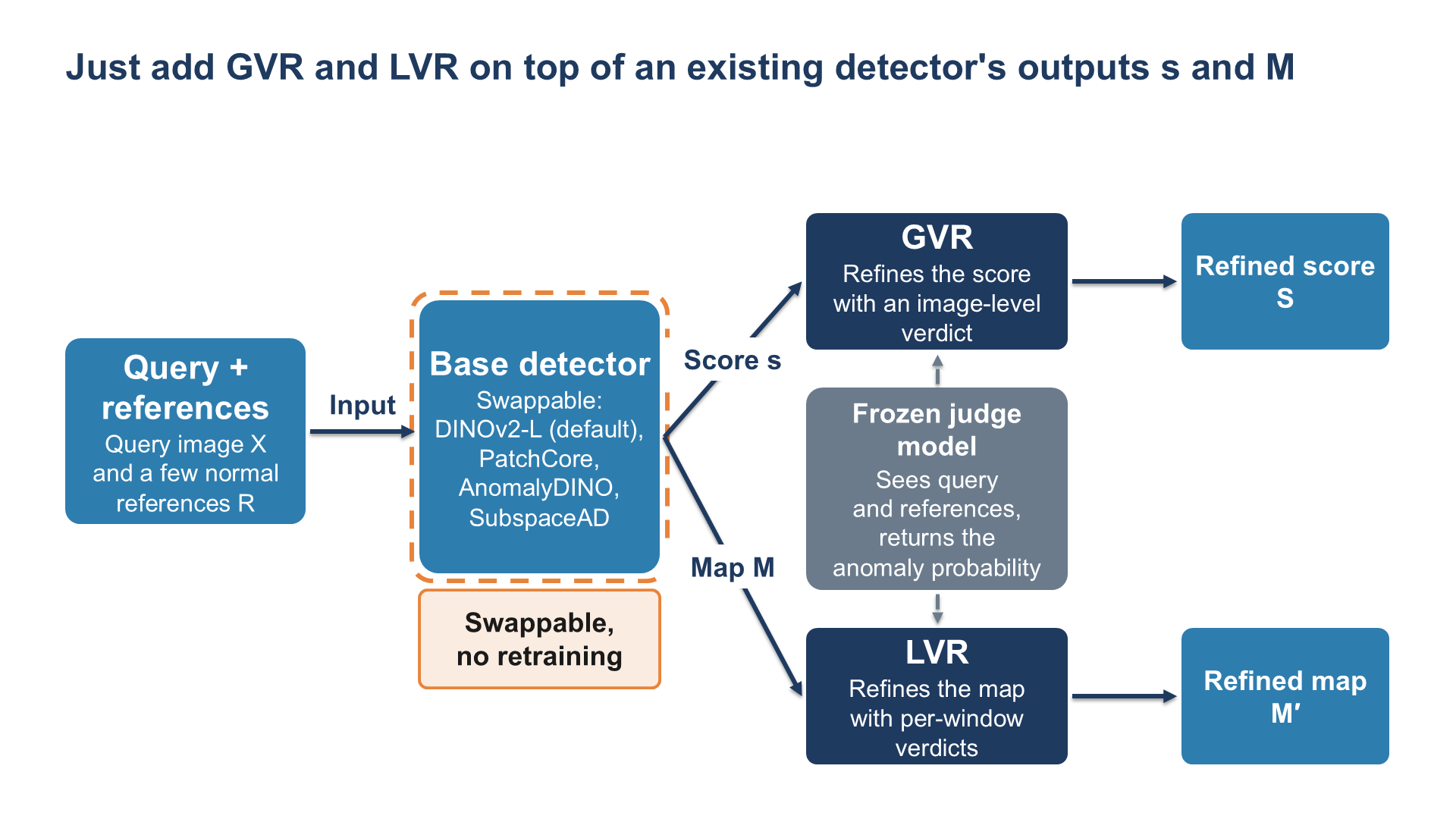
GVR and LVR are simply added on top of the existing detector's output (score s and anomaly map M). Created by TOMOMI RESEARCH based on Sun et al., arXiv:2611.02654.
Results: image-level AUROC improved in every reported combination
Image-level AUROC is the probability that a defective image is ranked above a good one. 50% is a coin toss; 100% is perfect separation.
| Detector | MVTec AD (1-shot) | VisA (1-shot) | MVTec LOCO AD (4-shot) |
|---|---|---|---|
| DINOv2-L | 94.3 → 97.5 | 92.0 → 95.7 | 68.7 → 77.5 |
| AnomalyDINO | 96.6 → 98.1 | 87.4 → 95.2 | 67.4 → 74.9 |
| SubspaceAD | 97.1 → 98.0 | 93.4 → 95.9 | 67.5 → 75.3 |
| PatchCore | 83.4 → (not reported) | 79.9 → (not reported) | 67.4 → 78.0 |
Image-level AUROC (%), before → after refinement, from Tab. 1 and Tab. 2 of the paper (mean of 3 seeds). These are values reported in the paper, not measured by TOMOMI RESEARCH. "1-shot" and "4-shot" refer to the number of good reference images.
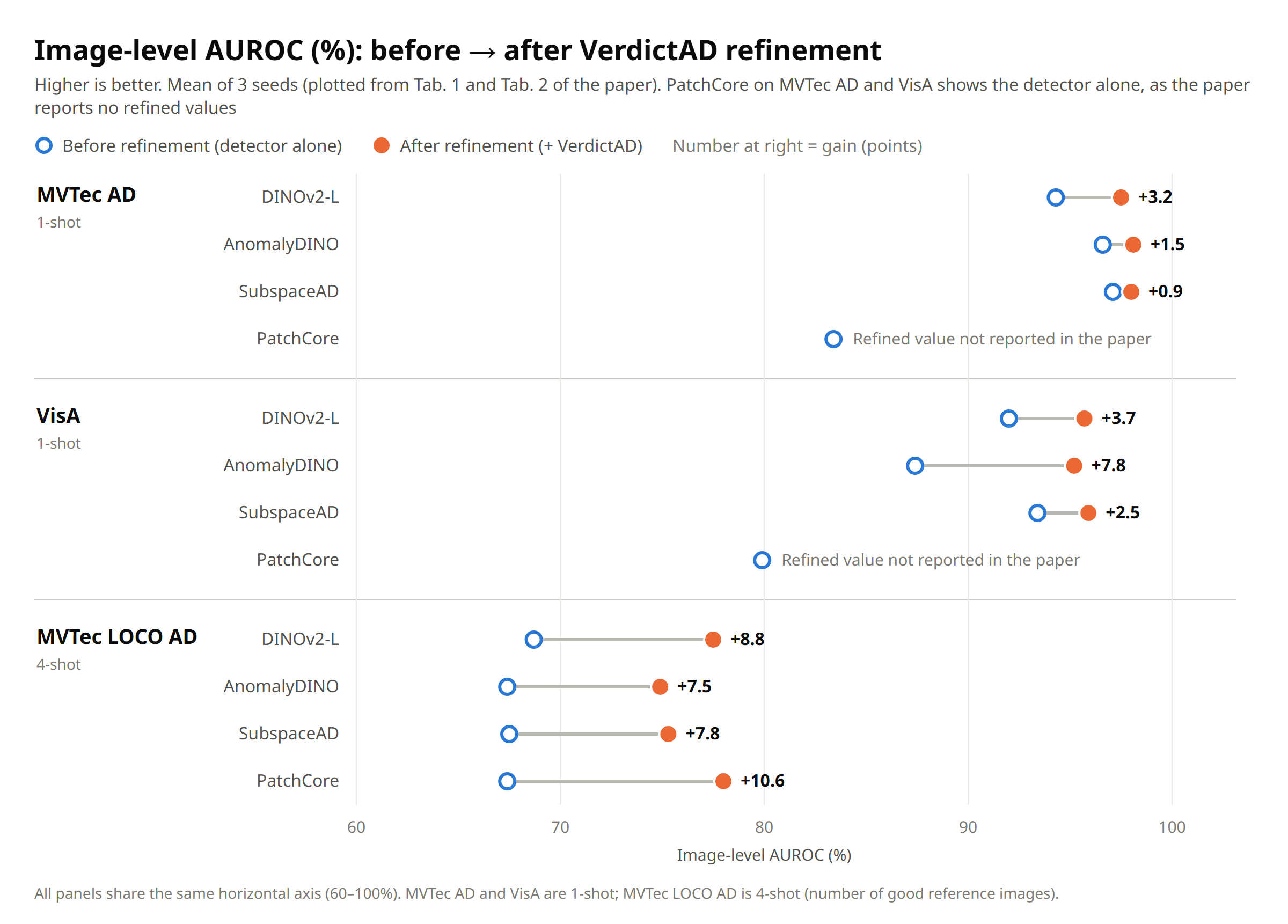
Open circles: before refinement; filled circles: after; numbers show the gain. Created by TOMOMI RESEARCH from the values in Sun et al., arXiv:2611.02654.
Three takeaways:
- The largest gain is on MVTec LOCO AD (4-shot), which includes logical anomalies. PatchCore rose from 67.4% to 78.0%, a gain of 10.6 points.
- Gains on MVTec AD (1-shot) are modest. Baselines were already at 94–97%, so improvements were about 1–3 points. VisA and MVTec LOCO AD show larger differences; on VisA (1-shot), AnomalyDINO gained 7.8 points.
- Every combination with a reported refined value improved. The paper does not report refined values for PatchCore on MVTec AD or VisA.
Limitations to check before considering it for a line
- It cannot recover defects the base detector missed. Because the refinement is multiplicative, it cannot create a signal that was never there. Even after refinement, image-level AUROC on MVTec LOCO AD stays around 75–78%.
- Inference cost is not reported. The paper gives no figures for compute cost or inference time. By our explainer team's own count from the described setup, the judge model is called 34 times per image (our estimate, not a figure reported by the authors). Whether it can keep up with line speed is unverified.
- Possible training-data overlap is not discussed. The paper does not address whether the judge model's training data overlaps with the benchmark images, so results on your own parts need separate validation.
- No production-line validation. Evaluation covers only three public datasets.
Summary
- In few-shot anomaly detection, "different" does not mean "defective": normal variation causes false positives, and missing parts are often mislocated.
- VerdictAD keeps the existing detector untouched and applies post-hoc refinement using the Yes/No probabilities of a frozen judge model.
- According to the paper, gains are largest on logical anomalies, but missed defects cannot be recovered, and inference cost and real-line fit remain open questions.
As a developer of AI for visual inspection, TOMOMI RESEARCH, INC. will keep sharing research that matters to the factory floor.
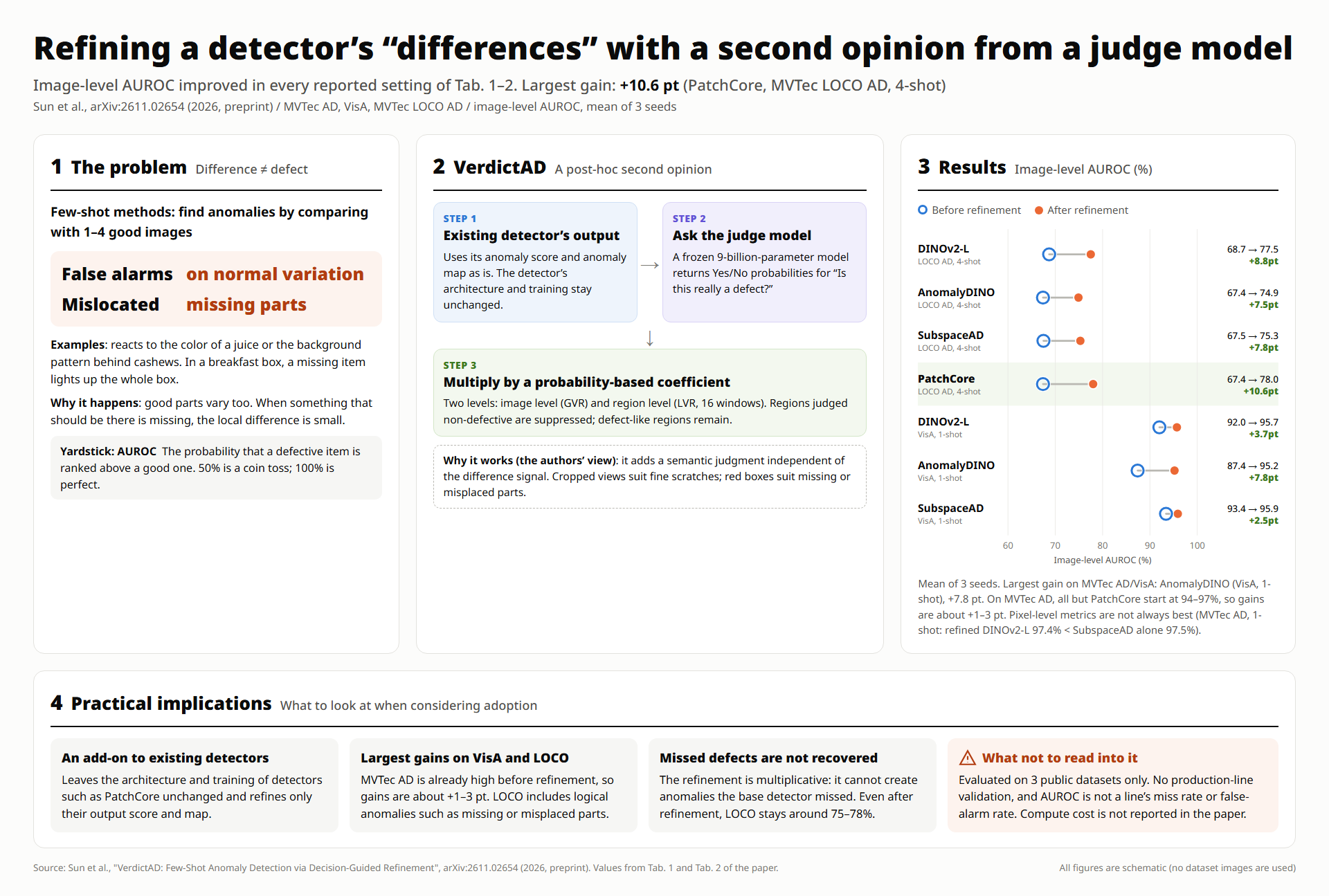
VerdictAD at a glance. Created by TOMOMI RESEARCH from the values in Sun et al., arXiv:2611.02654.
See the architecture diagrams and the step-by-step GVR/LVR flow in our explainer video (narration in Japanese).
▶ Watch the explainer video on YouTube (Channel: TOMOMI RESEARCH, INC. / @tomomi_research)
Reference
- Sun et al., "VerdictAD: Few-Shot Anomaly Detection via Decision-Guided Refinement," arXiv:2611.02654 (v1, preprint, not yet peer-reviewed)
- GitHub repository (checked on 2026-11-09)